



Bile Acids group - Dr Simon Peschard
Physiological Role of Bile Acids in Cardiometabolic Disease
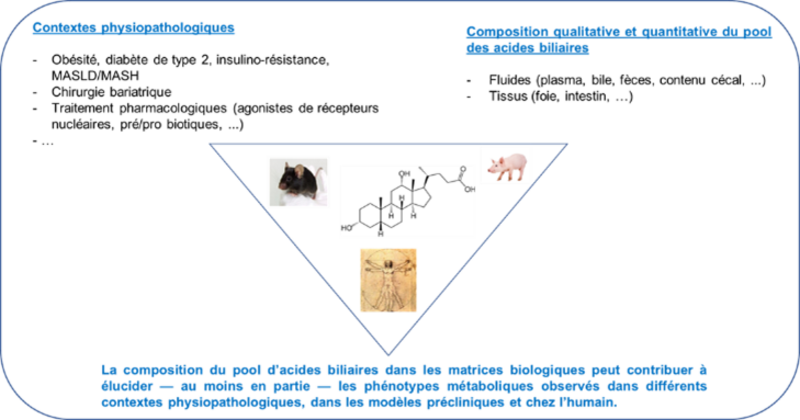
Prensation of research topics
The objective of the team is to investigate the pathophysiological role of bile acids (BAs) in cardiometabolic diseases (insulin resistance, type 2 diabetes, obesity, metabolic dysfunction-associated steatotic liver disease [MASLD], atherosclerosis, etc.) in humans and preclinical models (mouse and pig models).To this end, the qualitative and quantitative composition of the bile acid pool is determined in different biological matrices (systemic and portal blood, caecal contents, bile, faeces, milk, etc.) and analysed in relation to metabolic, clinical, and biological phenotypic characteristics. These analyses help identify the role of bile acids as contributors to and/or biomarkers of the pathophysiology of cardiometabolic diseases.
What are bile acids?
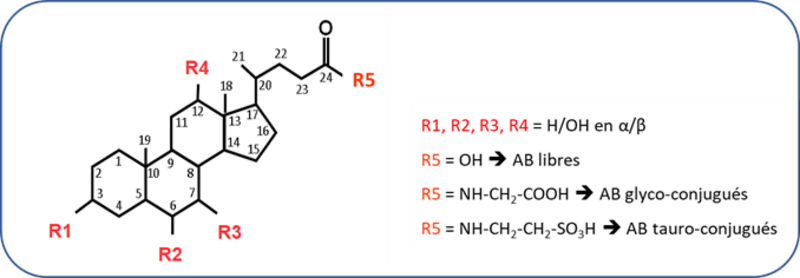
Bile acids are a large family of steroid molecules derived from cholesterol. They are found at high concentrations in the enterohepatic circulation and, to a lesser extent, in the systemic circulation. Approximately 25 major bile acid species are found in humans and 35 in mice
What is the pathophysiological role of bile acids?
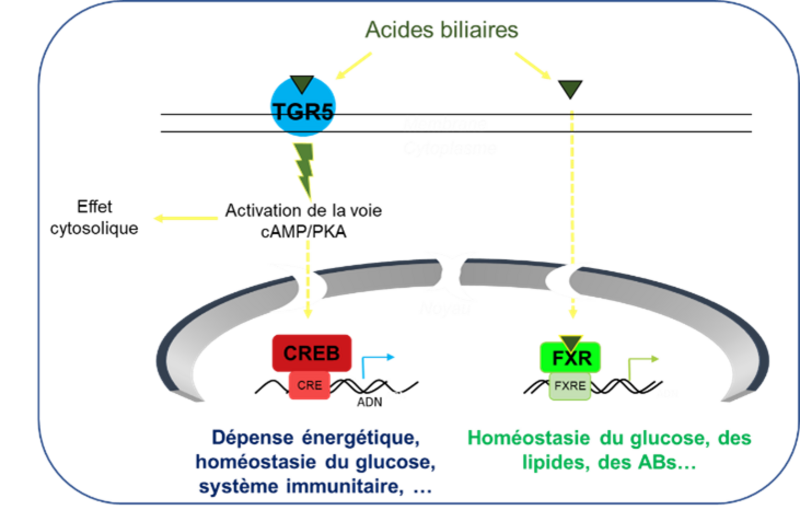
Bile acids (BAs) have been known for centuries for their detergent role in the intestinal absorption of fat-soluble molecules (lipids, vitamins, etc.). However, over the past two decades, these molecules have attracted renewed interest following the discovery of their role in regulating metabolic homeostasis. Indeed, BAs act as cell-signalling molecules that regulate carbohydrate and lipid metabolism, inflammation, and other physiological processes by binding to specific receptors. These include the nuclear receptor FXR (Farnesoid X receptor) and the G protein-coupled receptor TGR5 (Takeda G protein-coupled receptor 5), which are expressed in various metabolic tissues, including the intestine, liver, adipose tissue, and heart. Not all BAs activate these two receptors with the same potency or affinity. For example, CDCA is a potent activator of FXR, whereas TGR5 is activated by LCA. Thus, the qualitative and quantitative composition of the bile acid pool is a key determinant of metabolic homeostasis. Alterations in bile acid pool composition and disruptions in receptor-mediated signalling are associated with the development of cardiometabolic diseases, including obesity, insulin resistance, atherosclerosis, heart failure, and MASLD. Conversely, pharmacological modulation of bile acid signalling pathways has demonstrated therapeutic potential. Bile acids play a key role in inter-organ communication and are emerging as promising therapeutic targets for cardiometabolic diseases.
How is the bile acid pool determined?
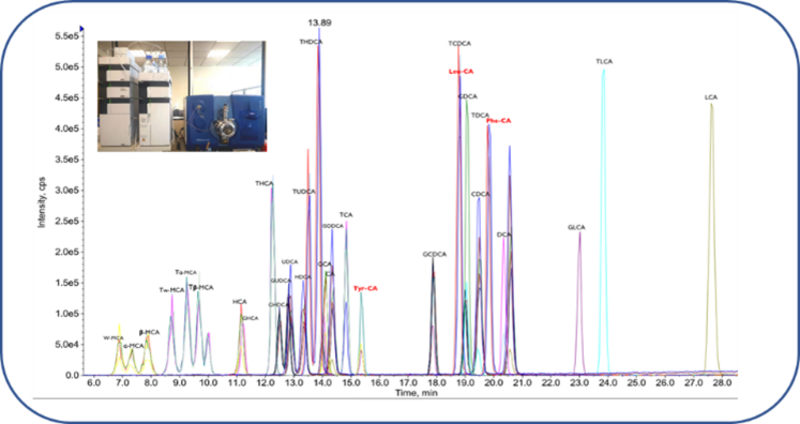
The different bile acid (BA) species that make up the bile acid pool are quantified using targeted metabolomics by liquid chromatography–tandem mass spectrometry (LC-MS/MS), following extraction from the biological matrix. These specialized analyses are performed in collaboration with the Mass Spectrometry Core Facility (PSM) – GRITA (Prof. JF Goossens), within the Department of Pharmacy, UFR3S. We quantify conventional bile acids (CA, CDCA, DCA, etc.), as well as bile acids produced by the gut microbiota and conjugated to amino acids (e.g., Phe-CA, Leu-CA, and Trp-CA) or LCA-derived bile acids (e.g., iso-alloLCA). These measurements are complemented by the quantification of C4 (7α-hydroxy-4-cholesten-3-one), a biomarker of hepatic bile acid biosynthesis.
Keywords
Bile acids; Cardiometabolic diseases; Preclinical models; Clinical studies; LC-MS/MS
Dr Simon Peschard, PhD.
Associate Professor, Lille University, Group leader
ORCID : 0000-0002-8207-6724
Dr Sandrine Caron-Houde, PhD, HDR.
Associate Professor, Lille University
ORCID : 0000-0002-4660-7436
Preclinical analyses article
Nawrot M, Peschard S, Thibaut MM, Ory K, Vallez E, Dorchies E, Touche V, Dubois-Chevalier J, Gheeraert C, Caron S, Bantubungi K, Lefebvre P, Tailleux A, Haas JT, Bindels LB, Leclercq I, Dombrowicz D, Lestavel S, Staels B. Intestinal FXR deficiency uncouples steatosis protection from liver inflammation and fibrosis in MASH-diet fed mice. Sci Rep. 2026 Jul 10. doi: 10.1038/s41598-026-60976-y
Marousez L, Descat A, Kouach M, Rakza T, Deruelle P, Staels B, Goossens JF, Tailleux A, Eberlé D. Maternal Obesity Increases Breast Milk Bile Acid Levels. J Clin Endocrinol Metab. 2026 Mar 17;111(4):e1116-e1123. doi: 10.1210/clinem/dgaf559.
Marciniak C, Chávez-Talavera O, Caiazzo R, Hubert T, Zubiaga L, Baud G, Quenon A, Descat A, Vallez E, Goossens JF, Kouach M, Vangelder V, Gobert M, Daoudi M, Derudas B, Pigny P, Klein A, Gmyr V, Raverdy V, Lestavel S, Laferrère B, Staels B, Tailleux A, Pattou F. Characterization of one anastomosis gastric bypass and impact of biliary and common limbs on bile acid and postprandial glucose metabolism in a minipig model. Am J Physiol Endocrinol Metab. 2021 Apr 1;320(4):E772-E783. doi: 10.1152/ajpendo.00356.2020.
Gillard J, Clerbaux LA, Nachit M, Sempoux C, Staels B, Bindels LB, Tailleux A, Leclercq IA. Bile acids contribute to the development of non-alcoholic steatohepatitis in mice. JHEP Rep. 2021 Oct 13;4(1):100387. doi: 10.1016/j.jhepr.2021.100387.
Clinical analyses article
Lalloyer F, Mogilenko DA, Verrijken A, Haas JT, Lamazière A, Kouach M, Descat A, Caron S, Vallez E, Derudas B, Gheeraert C, Baugé E, Despres G, Dirinck E, Tailleux A, Dombrowicz D, Van Gaal L, Eeckhoute J, Lefebvre P, Goossens JF, Francque S, Staels B. Roux-en-Y gastric bypass induces hepatic transcriptomic signatures and plasma metabolite changes indicative of improved cholesterol homeostasis. J Hepatol. 2023 Oct;79(4):898-909. doi: 10.1016/j.jhep.2023.05.012.
Schattenberg JM, Pares A, Kowdley KV, Heneghan MA, Caldwell S, Pratt D, Bonder A, Hirschfield GM, Levy C, Vierling J, Jones D, Tailleux A, Staels B, Megnien S, Hanf R, Magrez D, Birman P, Luketic V. A randomized placebo-controlled trial of elafibranor in patients with primary biliary cholangitis and incomplete response to UDCA. J Hepatol. 2021 Jun;74(6):1344-1354. doi: 10.1016/j.jhep.2021.01.013.
Grzych G, Chávez-Talavera O, Descat A, Thuillier D, Verrijken A, Kouach M, Legry V, Verkindt H, Raverdy V, Legendre B, Caiazzo R, Van Gaal L, Goossens JF, Paumelle R, Francque S, Pattou F, Haas JT, Tailleux A, Staels B. NASH-related increases in plasma bile acid levels depend on insulin resistance. JHEP Rep. 2020 Dec 16;3(2):100222. doi: 10.1016/j.jhepr.2020.100222. Erratum in: JHEP Rep. 2024 May 18;6(6):101097. doi: 10.1016/j.jhepr.2024.101097.
Chávez-Talavera O, Wargny M, Pichelin M, Descat A, Vallez E, Kouach M, Bigot-Corbel E, Joliveau M, Goossens JF, Le May C, Hadjadj S, Hanf R, Tailleux A, Staels B, Cariou B. Bile acids associate with glucose metabolism, but do not predict conversion from impaired fasting glucose to diabetes. Metabolism. 2020 Feb;103:154042. doi: 10.1016/j.metabol.2019.154042.
Legry V, Francque S, Haas JT, Verrijken A, Caron S, Chávez-Talavera O, Vallez E, Vonghia L, Dirinck E, Verhaegen A, Kouach M, Lestavel S, Lefebvre P, Van Gaal L, Tailleux A, Paumelle R, Staels B. Bile Acid Alterations Are Associated With Insulin Resistance, but Not With NASH, in Obese Subjects. J Clin Endocrinol Metab. 2017 Oct 1;102(10):3783-3794. doi: 10.1210/jc.2017-01397.
General Reviews
Oscar Chávez-Talavera+, Joel Haas+, Guillaume Grzych, Bart Staels# Anne Tailleux#. Bile acid alterations in non-alcoholic fatty liver disease, obesity, insulin resistance and type 2 diabetes: what do the human studies tell?. Curr Opin Lipidol, 2019 Jun;30(3):244-254. + Co-first authors, # Co-last authors
Tailleux A*, Chávez-Talavera O*, Lefebvre P, Staels B. Bile Acid Control of Metabolism and Inflammation in Obesity, Type 2 Diabetes, Dyslipidemia, and Nonalcoholic Fatty Liver Disease. Gastroenterology. 2017 152:1679-1694. *co-first authors.
Dr Simon Peschard, PhD.
Associate Professor, Lille University, Group leader
Laboratoire de Recherche J&K, Faculté de Médecine - Pôle recherche, Boulevard du Professeur J. Leclercq,
59045 Lille Cedex – France